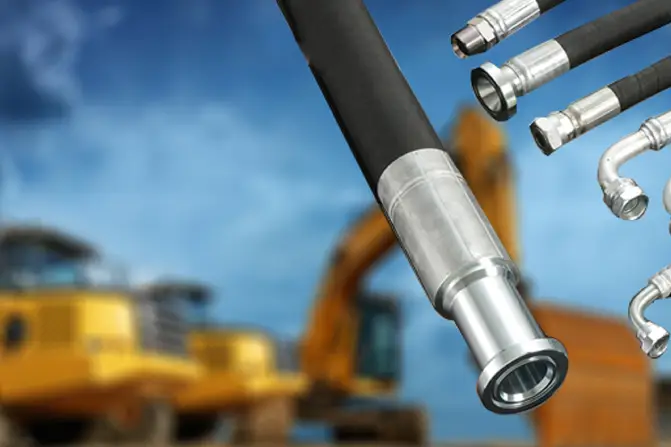
A top hydraulic hose manufacturer follows standards such as SAE J517, ISO 18752, EN 853, and ISO 9001 to control material quality, pressure performance, and production consistency. These manufacturers usually perform tests including impulse cycles, burst pressure tests, temperature resistance checks, and dimensional inspections. Many industrial hoses are designed for working pressures above 20 MPa and must pass pressure tests at 1.5 to 2 times their rated pressure before delivery.
Hydraulic hose quality depends on material selection, manufacturing control, testing procedures, and compliance with international standards. Companies serving construction, agriculture, mining, oil and gas, and industrial equipment markets usually follow strict production systems because hose failure can stop machinery and create fluid leakage risks.
A professional hydraulic hose manufacturer normally starts quality control from raw materials. Hydraulic hoses are made from three main parts: the inner tube, reinforcement layer, and outer cover. Each layer has a different function, and material selection affects pressure resistance, flexibility, and service life.
The inner tube must maintain compatibility with hydraulic fluids. Common materials include nitrile rubber (NBR), synthetic rubber, and thermoplastic compounds. NBR is widely used because it provides good resistance to petroleum-based hydraulic oils. In many industrial applications, hose materials are required to maintain stable performance between -40°C and +100°C.
Manufacturers often test rubber compounds before production, including tensile strength, hardness, elongation, and aging resistance. A typical industrial rubber compound may require tensile strength above 10 MPa and elongation levels above 200% depending on the hose type.
Material consistency is connected with reinforcement quality because the reinforcement layer carries most of the pressure load. Steel wire braid, steel wire spiral, textile fiber, and aramid reinforcement are common choices.
Different hose constructions match different pressure requirements:
| Hose Construction | Typical Application | Pressure Characteristics |
|---|---|---|
| Single wire braid | General hydraulic equipment | Medium pressure applications |
| Double wire braid | Industrial machinery | Higher pressure operation |
| Four spiral wire layers | Heavy construction equipment | High impulse pressure resistance |
| Textile reinforcement | Low-pressure systems | Flexible applications |
For example, SAE 100R1 hoses generally use one steel wire braid layer, while SAE 100R12 hoses use multiple spiral wire layers for demanding hydraulic systems. The reinforcement angle and wire tension must remain consistent because uneven placement can reduce fatigue resistance during repeated pressure changes.
Pressure testing is one of the most important procedures followed by established manufacturers. Hydraulic systems often experience repeated pressure increases and decreases during operation, so hoses must handle both normal pressure and temporary pressure peaks.
According to common industry requirements, manufacturers perform proof pressure tests at around 1.5 times the maximum working pressure. Burst tests are also used during product development to confirm safety margins. Some high-pressure hydraulic hoses are tested until failure at several times their rated working pressure to evaluate structural performance.
A hose rated for 35 MPa working pressure may need to withstand significantly higher pressure during qualification testing before it is approved for industrial use.
Impulse testing is another standard procedure. During impulse tests, hoses are exposed to repeated pressure cycles under controlled temperature conditions. SAE J517-based testing methods may require hundreds of thousands of pressure cycles depending on hose category.
These tests simulate real equipment conditions such as excavator arm movement, hydraulic cylinder operation, and industrial machine cycling. A hose that performs well during static pressure testing may still fail during repeated movement if the reinforcement structure is not properly designed.
Dimensional control is also included in the production process. Manufacturers measure inner diameter, outer diameter, wall thickness, and fitting dimensions to ensure compatibility with hydraulic systems.
Even small dimensional differences can affect fluid flow and connection performance. For example, incorrect inner diameter may increase pressure loss and generate additional heat. Professional factories usually use automated measurement equipment to reduce production variation.
Coupling assembly receives similar attention because many hydraulic hose problems occur near fittings. The connection between hose and fitting must provide strong mechanical holding force without damaging the inner tube.
Manufacturers use controlled crimping machines to install fittings. Each assembly is checked by measuring crimp diameter according to technical specifications. Incorrect crimping can cause fitting separation or leakage during high-pressure operation.
International standards provide the technical foundation for these processes. SAE J517 remains one of the most commonly referenced hydraulic hose standards worldwide, while ISO 18752 provides performance classifications based on pressure capability and application requirements.
ISO 18752 was introduced to simplify hose selection by using consistent pressure ratings across different hose sizes. Many global equipment manufacturers use this standard when selecting components for machines sold across multiple markets.
Quality management systems also influence manufacturing reliability. Many established hose producers operate under ISO 9001 quality management requirements, which were first published in 1987 and continue to be widely adopted.
| Quality Control Area | Typical Inspection Method |
|---|---|
| Rubber compound | Tensile and aging tests |
| Reinforcement wire | Strength and placement inspection |
| Hose assembly | Crimp measurement |
| Finished hose | Pressure testing |
| Production records | Batch traceability |
Traceability systems allow manufacturers to record production information for each batch. Records may include raw material suppliers, production dates, machine settings, inspection results, and final approval status.
This process helps equipment manufacturers identify product information quickly when maintenance or quality reviews are required. In industries such as mining and offshore equipment, where machines may operate continuously for thousands of hours per year, detailed production records are commonly required.
Temperature resistance testing is also necessary because hydraulic equipment operates in different environments. Construction machines may work outdoors in cold regions, while industrial systems may operate near heat sources.
Manufacturers test hoses under low and high temperature conditions to confirm flexibility and sealing performance. Some specialized hydraulic hoses are designed for temperature ranges from approximately -55°C to +135°C.
Abrasion resistance is another consideration for mobile machinery. Excavators, loaders, and agricultural equipment often expose hoses to vibration and external contact. Outer covers are designed with abrasion-resistant compounds to improve service life.
Ozone resistance testing is also performed because rubber materials can degrade when exposed to environmental conditions for long periods. Manufacturers evaluate cracking and surface changes after controlled ozone exposure.
Production technology affects final hose consistency. Modern facilities often use automated extrusion equipment, computer-controlled braiding machines, and digital inspection systems. Automation reduces variation between production batches and improves repeatability.
A reliable manufacturer also provides technical documentation, including product specifications, pressure ratings, temperature ranges, and test records. These documents help customers select suitable hoses for different hydraulic applications.
High-quality hydraulic hoses come from controlled materials, standardized testing, accurate assembly, and consistent production processes.
The standards followed by leading hydraulic hose manufacturers allow products to perform safely in demanding environments. Through compliance with SAE and ISO requirements, detailed inspection procedures, and continuous production control, manufacturers produce hoses suitable for construction machinery, industrial systems, agricultural equipment, and heavy-duty hydraulic applications.