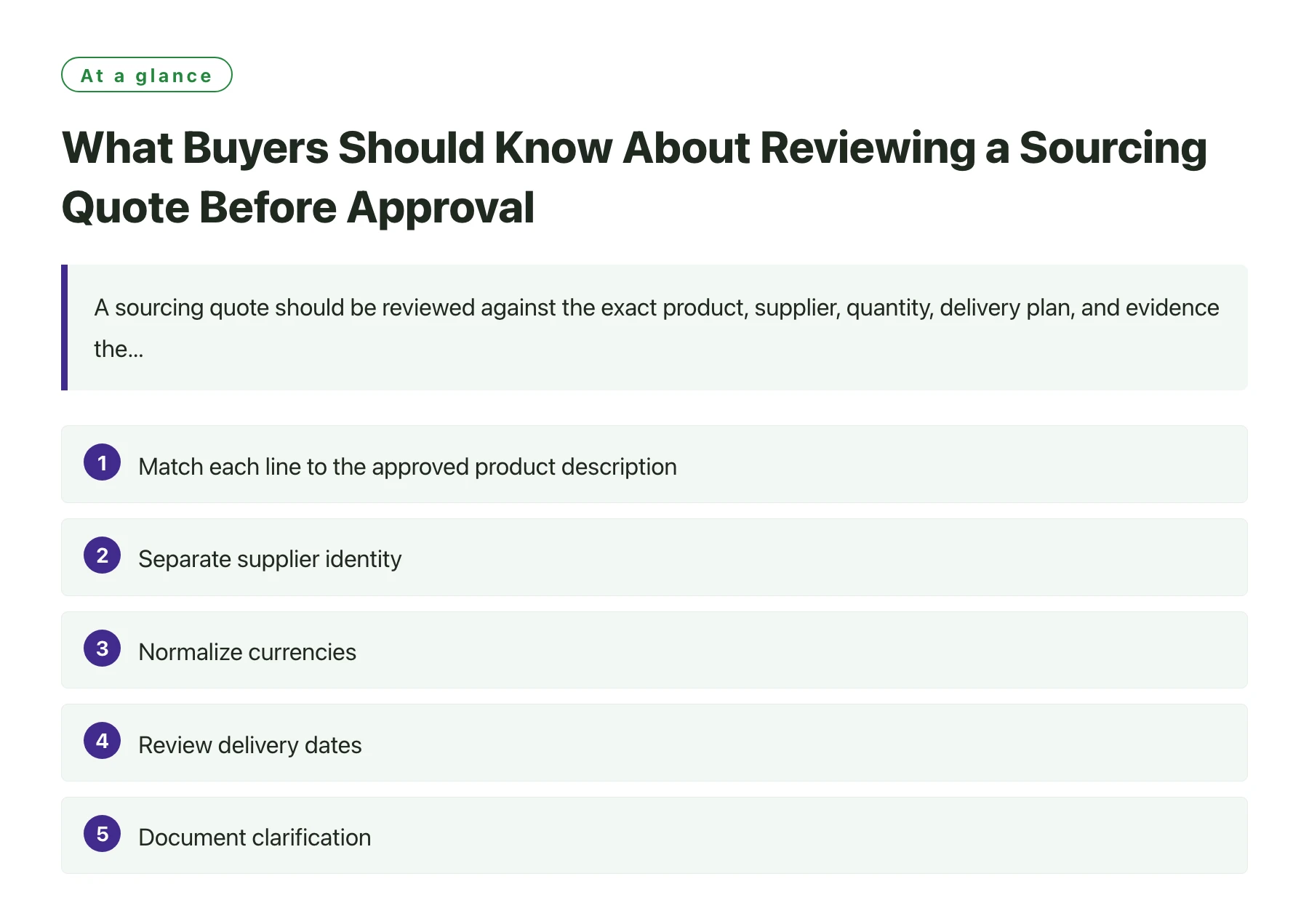
A sourcing quote should be reviewed against the exact product, supplier, quantity, delivery plan, and evidence the buyer needs. Before approval, normalize specifications and revisions, verify who is quoting and producing, identify fees and exclusions, and compare shipment and quality assumptions. A short price line can hide differences in packaging, tests, tooling, lead time, or commissions. Record clarifications and approval authority so the purchase order does not rely on an unverified interpretation.
Key takeaways
- Match each line to the approved product description, model, revision, and quantity.
- Separate supplier identity, manufacturing site, intermediary role, and payment entity.
- Normalize currencies, terms, fees, tooling, freight, packaging, and quote validity.
- Review delivery dates, capacity assumptions, quality evidence, and open deviations.
- Document clarification, approval, and change control before purchase order release.
Use a comparison sheet so price and risk assumptions are visible across suppliers.
1. Does the quotation match the request?
Compare each quoted line with the request for quotation, technical specification, drawing, bill of materials, finish schedule, and approved sample. Check product code, dimensions, materials, accessories, packaging, quantity, unit of measure, and revision. Highlight any phrase such as “equivalent,” “standard option,” or “as discussed” that could conceal a difference from the buyer’s request.
Ask suppliers to list deviations in a separate column with price, lead-time, quality, and approval impact. Keep alternate offers separate from the base quote. If a buyer accepts a substitution, update the controlled specification and purchase documents before production. A supplier’s ability to provide a similar product is not approval to change the ordered item.
2. Who is quoting, contracting, and producing?
Record the legal entity that prepared the quotation, the entity that will contract, the entity receiving payment, the exporter, and the production site. Ask whether the quoted provider is a factory, trading company, agent, or combination. Check whether the name and address correspond across company records, quote, bank instructions, and any factory evidence. Resolve differences with traceable explanations.
Ask how the supplier was selected and whether commissions, referral fees, or related-party arrangements affect the recommendation. CIPS supplier-evaluation guidance describes setting criteria and assessing supplier capabilities and resources; apply that discipline to both the supplier and any intermediary involved in the quotation. [1]
3. Is the pricing basis complete?
Check currency, unit, quantity breaks, minimum order, validity, deposit, balance, taxes, tooling, samples, tests, certification, inspection, packaging, palletization, and bank charges. Confirm whether prices are per piece, set, carton, square metre, or another unit. Normalize exchange-rate assumptions and quote dates when comparing bids received at different times.
Separate product price from sourcing fees, commissions, inspection charges, translation, logistics coordination, and third-party services. Ask whether a percentage fee is calculated on product price, freight, taxes, or total landed cost. Require prior approval for new charges. A quotation that calls a service “included” should specify the actual deliverable and any limit on visits, revisions, or reporting.
4. What delivery and capacity assumptions are embedded?
Confirm production lead time, sample approval date, capacity reserved, raw-material availability, factory calendar, holiday shutdowns, and order sequence. Distinguish manufacturing time from inspection, packing, inland transport, export documentation, freight, customs, and final delivery. Ask what milestones trigger the delivery estimate and how the supplier will report slippage.
Review the named delivery term, edition, and place if Incoterms are used. Confirm who arranges pickup, export clearance, freight, insurance, unloading, and import clearance. Ask whether the quoted transit schedule is an estimate or a booked service. A target arrival date should include realistic buffers and a clear owner for each logistics stage.
5. Which quality and compliance items are included?
Check whether the quote includes the approved sample, specified materials, functional checks, production inspections, test reports, certificates, labels, instructions, and corrective-action support. Match every document promise to the model, factory, and market. Identify tests that are excluded, charged separately, or expected from the buyer. Route regulatory decisions to a qualified owner rather than interpreting a generic certificate as product approval.
Define which inspection stage, sample method, acceptance criteria, and report are included. Clarify reinspection cost and what happens if goods fail. Ask how a factory or component substitution is approved. If the quote uses phrases such as “quality standard applies,” identify the exact standard, revision, test method, and acceptance rule.
6. Are commercial and legal terms clear?
Review quote validity, payment milestones, late delivery remedy, cancellation, warranty, intellectual property, confidentiality, tooling ownership, liability, force majeure, dispute process, and governing documents. Identify the law and contract entity with qualified counsel when the order warrants it. A quote may be subject to supplier terms that conflict with the buyer’s purchase conditions; resolve precedence before payment.
Check bank details using an independent verified channel when they change or differ from past records. Do not approve a payment instruction solely because it arrived in the same email thread as the quotation. Record the verified beneficiary, currency, amount, and approval. Escalate unusual urgency or unexplained account changes through the buyer’s payment-control process.
7. Compare offers on total cost and risk
Use a matrix with base price, fees, tooling, sample, test, inspection, packaging, freight assumptions, schedule, quality evidence, supplier capability, deviations, and open questions. Set mandatory thresholds for technical or compliance requirements before weighted commercial scoring. CIPS encourages evaluation against stated criteria; write the reason behind each rating so the decision remains explainable after the award.
Model at least the expected cost and a plausible risk case, such as rework, delayed shipment, extra inspection, or broken packaging. Do not add speculative costs without a basis, but expose who bears each known risk. Ask suppliers to clarify gaps using the same question set so the comparison remains fair and complete.
8. Record approval and control the handoff
Before approval, close material questions, confirm final price and validity, identify the approved supplier and site, and verify that specification, quotation, and purchase order agree. Record approver name, date, revision, and conditions. Preserve clarifications, attachments, and any accepted deviation in the order file.
Review the scope of a proposed JS Sourcing China sourcing agent before approving the sourcing quote. Ask which supplier checks, comparison work, quality coordination, and records are included, then connect those deliverables to the purchase order and project responsibilities. Once approved, require changes to return through the same documented review path.
Sources
Frequently asked questions
What is the first thing to check in a sourcing quote?
Match product identity, specification revision, quantity, unit, and packaging to the approved request. Resolve substitutions or vague scope language before comparing price.
Should freight be included when comparing supplier quotes?
Compare the same delivery basis. Show freight, insurance, customs, unloading, and destination transport separately when they are not included, and confirm the named place and responsible party.
How should a buyer review commissions or sourcing fees?
Request a written fee schedule and disclose supplier-paid commissions or referral arrangements. Confirm the calculation base, exclusions, approval process, and total cost under the same assumptions.
When is a sourcing quote ready for approval?
Approve after supplier and site identity, product scope, price assumptions, delivery, quality evidence, deviations, commercial terms, and decision ownership are clear and documented.