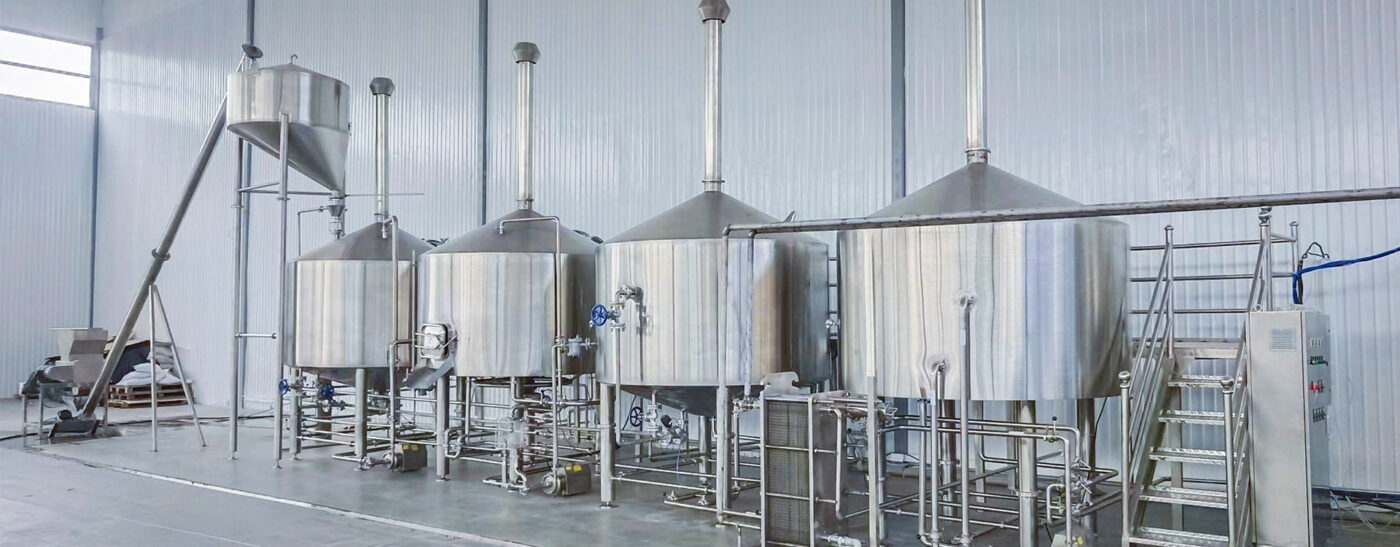
A turn-key brewery improves workflow by matching brewing, fermentation, cleaning, cooling, utilities, and packaging as one production system instead of treating each machine separately. In a 20 hL brewery running four brews per day, saving 20 minutes per batch releases about 80 minutes of operating time. A properly sized Brewhouse, cellar, glycol loop, and CIP station also reduce waiting between transfers. Typical breweries use roughly 4–7 liters of water per liter of beer, while well-managed plants can operate closer to 3–4 liters. Better heat recovery, automated valve sequencing, and balanced tank capacity can reduce utility use and shorten turnaround without increasing brewhouse size.
Most workflow problems start with mismatched capacity. A 20 hL brewhouse producing four batches per day can send 80 hL of wort to the cellar, but production slows immediately if only one 40 hL fermenter is available or if the glycol system cannot remove fermentation heat at the required rate. A turn-key design sizes hot-side output, fermentation volume, cooling capacity, transfer pumps, and packaging throughput together, so each production stage receives product at a usable rate.
The same capacity logic applies inside the Brewhouse. Mash conversion may take around 45–60 minutes, lautering often needs another 60–120 minutes, and wort boiling commonly runs for 60–90 minutes depending on recipe and evaporation targets. If vessel scheduling is poorly arranged, a kettle can sit empty while the lauter tun remains occupied, reducing the number of batches completed within an 8- or 10-hour shift.
A brewery that removes 15 minutes of waiting from four daily batches gains one full production hour every day. Across 250 brewing days, that equals about 250 hours of additional equipment availability without adding another vessel.
Turn-key layouts reduce that waiting by planning process sequence before installation. Mash vessels, lauter tuns, kettles, whirlpools, heat exchangers, fermenters, and bright beer tanks are positioned around transfer distance, pump duty, cleaning access, and utility routing. A transfer line shortened from 25 meters to 10 meters contains less residual beer or wort, needs less rinse water, and takes less time to clean.
Pipe diameter also affects flow. A line carrying 40 hL per hour requires a different diameter and pump selection from one carrying 10 hL per hour. Oversized pumps can create excessive flow velocity and foaming, while undersized pumps extend transfer time. Many beer-transfer systems operate around 1–2 meters per second, depending on product condition, pipe size, and sanitation requirements, so hydraulic sizing needs to match actual production volume.
Automation adds another layer of control. A PLC-based system can manage temperature setpoints, pump starts, valve positions, vessel levels, alarms, and timed process stages from one interface. In a four-vessel brewhouse, automating repeated valve changes can remove dozens of manual operations during a brewing day, especially when 3–6 batches are produced within the same shift.
The benefit becomes clearer when recipe repeatability matters. If one mash rests at 65°C and another reaches 67°C because heating and recirculation are handled differently, fermentability may change. Automated temperature control can typically hold process temperatures within a narrow operating band when sensors, steam valves, and control loops are correctly commissioned. Stable process conditions reduce variation between batches and simplify operator training.
Cleaning deserves equal attention because brewing equipment cannot produce while it is being cleaned. A manual cleaning sequence may require hose changes, chemical preparation, heating, circulation, rinsing, and verification. A centralized CIP station can prepare caustic, acid, sanitizer, and rinse water in dedicated tanks, allowing cleaning cycles to follow repeatable time, temperature, concentration, and flow settings.
Typical brewery caustic cleaning solutions may be used around 1–3% concentration, depending on chemical supplier instructions, soil level, temperature, and equipment material. Cleaning temperatures often fall within roughly 60–80°C for suitable alkaline cycles. A turn-key system can also return cleaning liquid through fixed piping, reducing repeated hose movement and shortening the gap between one tank release and the next production use.
| Workflow area | Poorly coordinated setup | Integrated turn-key setup |
|---|---|---|
| Wort production | Vessels wait for one another | Batch timing follows a planned sequence |
| Beer transfer | Long hose runs and manual valves | Fixed routing and matched pumps |
| Cleaning | Separate manual preparation | Centralized CIP recipes |
| Cooling | Chiller selected only by tank count | Cooling sized for peak demand |
| Packaging | Filler waits for cellar supply | Tank release follows packaging rate |
Cooling is often underestimated because fermentation tanks do not all demand maximum cooling at the same moment. A 100 hL tank during active fermentation can release much more heat than the same tank during cold storage. A turn-key engineering study reviews fermentation heat, crash-cooling schedules, ambient conditions, piping losses, and simultaneous tank demand before choosing chiller capacity.
That planning can prevent a common production delay: beer scheduled for packaging tomorrow may still be above the required temperature because several tanks were crash-cooled at once. Cooling beer from 20°C to 2°C requires removing about 75 kJ of heat per kilogram before accounting for tank heat gain and system losses. For 10,000 liters of beer, the cooling requirement is therefore substantial and must be spread across enough refrigeration capacity.
Water management has a similar effect on workflow. Industry figures commonly place brewery water use around 4–7 liters of water per liter of packaged beer, although efficient plants can approach 3–4 liters. Water is consumed in brewing, vessel rinsing, floor cleaning, packaging, cooling, and CIP, so piping design and cleaning procedures influence both operating cost and production time.
Heat recovery can lower part of that demand. Wort leaving the whirlpool may be close to 95°C, while fermentation temperature can be near 18–22°C for many ales. A plate heat exchanger can transfer a large portion of that heat into incoming brewing water, creating hot water for the next mash or cleaning cycle. Recovering heat during every batch reduces boiler demand and can shorten the time needed to prepare the next production step.
Fermentation capacity then determines how much of the brewhouse output can become saleable beer. A brewery producing 80 hL per brewing day but using 40 hL fermenters needs at least two available tanks for that day's wort. If fermentation and maturation occupy a vessel for 14 days, a simple schedule already requires significant cellar space before seasonal peaks, dry-hopping time, or longer lager conditioning are included.
Turn-key cellar planning usually starts with annual output, weekly brewing frequency, batch size, fermentation duration, and expected beer mix. A plant producing 5,000 hL per year at 50 hL per fermentation batch requires around 100 full fermentation cycles annually before losses are considered. Increasing average tank occupancy from 14 to 21 days changes the required vessel count substantially, even though the brewhouse output remains unchanged.
Packaging must be included in the same calculation. A canning line rated at 3,000 cans per hour processes about 9.9 hL per hour when filling 330 mL cans before allowances for stoppages, changeovers, rinsing, foam control, and product losses. If a bright beer tank holds 50 hL, several hours of stable packaging operation are required to empty it.
A filler that stops repeatedly can keep bright tanks occupied and delay beer leaving fermentation tanks. For that reason, turn-key projects usually examine filler speed, package size, conveyor layout, CO₂ supply, compressed air, rinse water, drainage, labeling, carton handling, and finished-product space together rather than placing a filler into whatever floor area remains.
-
A 30-minute packaging changeover repeated twice per day consumes 250 hours over 250 production days.
-
Reducing each changeover by 10 minutes returns about 83 hours per year.
-
Cutting a 20-minute tank-transfer setup to 10 minutes across six daily transfers saves one hour per operating day.
-
Reducing brewery water use from 6 L/L to 4 L/L saves 2,000 liters for every 1,000 liters of packaged beer.
Commissioning also affects the first months of production. Equipment can operate correctly on its own and still perform poorly when connected to another system. A pump may deliver the required flow but overwhelm a downstream filter, or a steam system may heat one vessel correctly but lose pressure when two vessels call for steam together. System testing checks complete production sequences rather than individual machines only.
A proper commissioning program tests water runs, heating rates, pump curves, valve logic, level sensors, temperature sensors, CIP return flow, glycol circulation, alarms, emergency stops, and packaging supply. For a plant with 30 automated valves, verifying every commanded position before beer production can prevent many hours of troubleshooting during the first commercial batches.
Maintenance access should be planned at the same stage. A pump that requires two hours of pipe removal before its seal can be replaced creates more downtime than a pump installed with proper isolation valves and service clearance. Spare valve seats, pump seals, temperature sensors, gaskets, and commonly used fittings can also reduce repair delays when the plant operates 5–7 days per week.
Expansion planning keeps later production changes manageable. Adding four more fermenters may appear simple, but the existing glycol headers, electrical capacity, compressed-air system, CO₂ distribution, CIP return, drainage, and control panel must support them. Reserving connections and panel capacity during the first installation costs less than rebuilding utility routes after tanks are already operating.
For example, a brewery starting with six 40 hL fermenters may plan floor space and utility connections for ten vessels. The initial production system remains sized for six tanks, while pipe headers, control architecture, and service access can be arranged so the additional four tanks can be installed without moving the original cellar.
Labor efficiency improves when operators spend less time moving hoses, opening valves, recording temperatures, or waiting for utilities. Saving 45 minutes across an 8-hour shift equals about 9.4% of one operator's working time. In a brewery running two shifts over 250 days, the accumulated difference reaches 375 labor hours per year.
The strongest turn-key workflow therefore comes from matching time, volume, flow, temperature, cleaning, utilities, cellar occupancy, and packaging capacity before equipment reaches the site. A brewery producing four batches per day has hundreds of transfers, cleaning events, valve operations, and temperature changes every month; reducing a few minutes from repeated tasks can add hundreds of usable production hours over a year.